
When sachet packs need a mark that stays legible
Sachets often move through sealing, boxing and delivery with very little spare room for print. A handheld inkjet coder gives a clean expiry mark on flexible packs where the operator needs to work around seams, gussets and uneven stacking. On many jobs the mark is only a few characters long, yet it still has to stay readable after handling, rubbing and refrigeration.
For this use case, the right setup is shaped by the sachet material, the print area and how the line runs at the factory. Some film surfaces take solvent-based ink better, especially where the pack may pick up moisture in Durban, Richards Bay or other coastal towns. Water-based ink can suit porous outer packaging, while quick-dry ink is often preferred where the sachet touches other packs soon after coding. The aim is plain and practical: clear dates, neat batch details and no heavy ink spread.
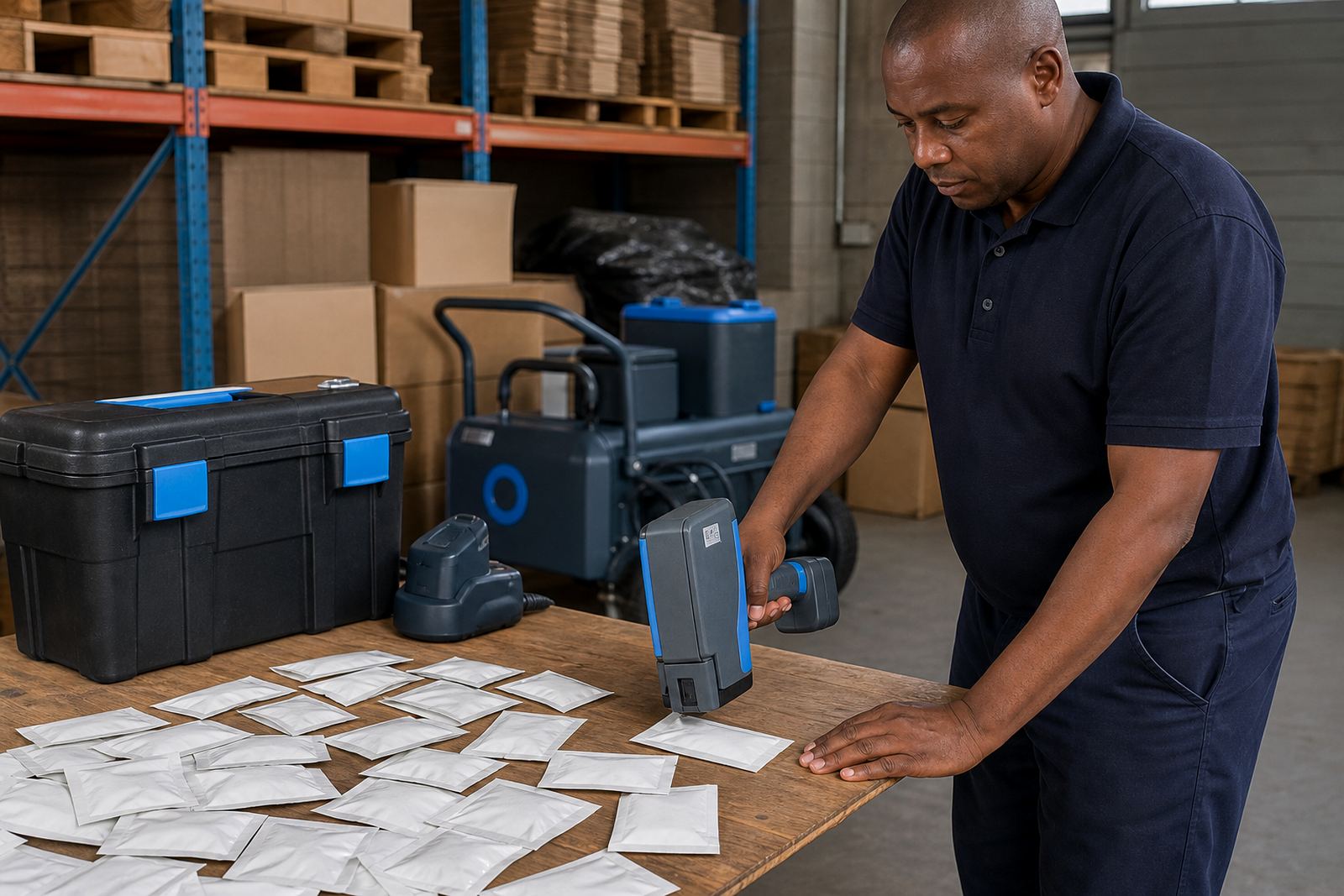
Typical handheld coder set for flexible packs
A sachet marking job usually calls for a compact handheld printer, the correct ink type and a clear print plan before the first pack is marked. Print height matters because a sachet face may only allow a narrow band of text. Many operators work with a small character height for dates and batch codes, then a slightly larger setting for a short logo or product line name.
- Handheld inkjet coder with adjustable print height for small coding windows.
- Solvent, water-based or quick-dry ink matched to the sachet material.
- Message loading for expiry dates, batch codes and simple product text.
- Barcode setup where the sachet needs scan-ready code marks on outer packs.
- Test printing on sample sachets before live use starts.
- Consumables supply for jobs that run over weekly or monthly hire periods.
When the pack is thin, the coder operator also needs to keep hand pressure steady. A rushed pass can leave a faded date or a broken barcode, and that creates waste on the packing table. For this reason, training and test prints are worth doing before the full run begins.
Planning the print area on sachets and small pouches
Sachet print planning starts with the fold, the seal line and the place where a carton handle or wrap may hide the code. Many clients want the date on the back seam, but that is not always the best spot if the sachet gets folded in transit. A better location may be a flat panel that stays visible after filling and sealing.
For multiple pack sizes, it helps to map each SKU with a separate message set. That keeps the expiry position consistent from one product run to the next. If a sachet carries a barcode, leave enough white space around the code so scanners do not struggle with print bleed or background pattern.
Remote setup help works well when the site has a clear sample pack and a list of codes to load. On-site setup is useful when the packing team wants the print pattern checked against the real workflow. In both cases, the practical aim is to keep the print readable without slowing the packing crew.
Common errors on sachet expiry work
Many sachet coding problems start with ink choice, not the printer itself. A solvent ink may be needed on a glossy film, while a water-based ink can smudge if used on the wrong surface. Quick-dry ink helps on packs that are stacked soon after coding, but it still needs the correct print distance and a steady hand.
- Printing too close to the seal line and losing part of the message.
- Using a print height that is too large for the available space.
- Loading a barcode that is too dense for a small sachet panel.
- Skipping test prints on the same material that will go into production.
- Choosing ink without checking the film finish or handling conditions.
Another common issue is trying to print on a curved or wrinkled section of the sachet. That can distort the characters and make the date hard to read. A flat area, even a narrow one, usually gives cleaner results than a larger but uneven patch.
Hire terms and budget bands in rand
For sachet expiry marking, weekly hire suits short production runs, packaging trials and projects with changing artwork. Monthly hire works better where the same pack codes repeat across regular output and the team needs the coder on hand more often. Delivery and collection can be arranged across South Africa, including Durban, Pietermaritzburg, Johannesburg, Cape Town and Richards Bay.
Budget planning depends on the model, the ink type, setup work and any extras such as barcode loading or backup unit support. As a practical guide, smaller hire jobs may sit in a lower rand band, while longer monthly arrangements with training, consumables and field setup naturally move higher. The final figure is shaped by the surface, the number of messages and the level of support needed on site.
If the sachet line runs on mixed pack sizes, it can also help to factor in logo setup and test printing. That keeps the job tidy from the first shift, and avoids repeated changes when the packing table is already busy.
Practical support for Pinetown and beyond
The Pinetown base serves nearby industrial areas such as Westmead and New Germany, while hire work also reaches Durban, Pietermaritzburg, Johannesburg, Cape Town and Richards Bay. The team can assist with ink selection, message loading, operator training and troubleshooting support where sachets, cartons or outer bags all sit in the same job.
Sibusiso Moagi oversees the operation with a team that handles hire coordination, technical support, training, administration and field setup. For sachet expiry work, that mix matters because one site may need a neat message layout, while another needs a barcode set-up that fits a small flexible pack without crowding the panel. The contact route is the enquiry form on our contact page, which is used for hire requests and setup details.